Medicare’s October NCD Coding Update Reaches Back to 2024. MACs Will Not Search for Your Claims.
CMS’s quarterly NCD coding update took effect for Medicare contractors on October 5, 2026. Several changes carry effective dates from 2024 through 2026, and contractors will adjust earlier claims only when providers bring them forward.
CMS’s October 2026 update to the coding inside National Coverage Determinations (NCDs) has an implementation date of October 5, 2026. It is issued as Transmittal 13968, Change Request 14464, dated September 24. That transmittal replaced an August 14 version (Transmittal 13910) and removed the stem cell NCD items, which CMS says will move to an April 2027 change request.
CMS describes the update as a quarterly maintenance of ICD-10 conversions and other coding updates and states that no policy is changing. That is true for coverage criteria. It is not the same as saying nothing changes for claims. Several of the edits carry effective dates well before October, and the instruction tells contractors not to go looking for the affected claims.
What changed, and the dates that matter
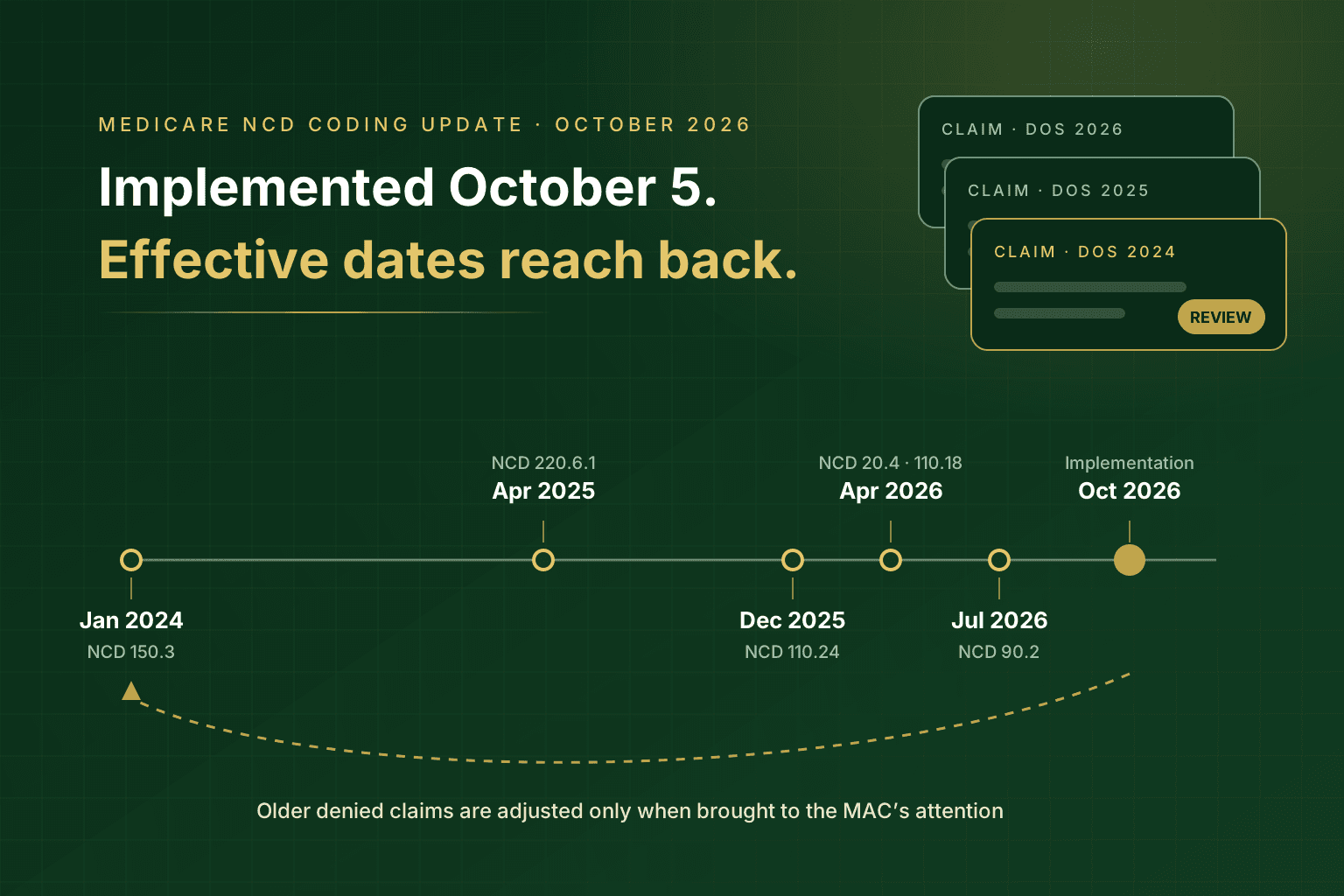
The October update touches six NCDs. The effective date listed for each change is the date to compare against the date of service on any claim that was denied or never billed:
- NCD 150.3, bone (mineral) density studies: Category III codes 0554T through 0558T added as payable, effective January 1, 2024, for diagnostic indications only (not monitoring), with coinsurance and deductible waived and frequency edits updated.
- NCD 220.6.1, PET for perfusion of the heart: CPT codes 78430 through 78434 added to the edit logic, existing edits made overridable effective April 1, 2025, and tracer codes moved to a list contractors can maintain, including A9598 (effective January 1, 2018) and A9611 (effective April 1, 2025).
- NCD 20.4, implantable cardioverter defibrillators: three ICD-10-PCS procedure codes (02HM3KZ, X2HM3GB and X2HV3GB) added as covered, effective April 1, 2026.
- NCD 110.18, aprepitant for chemotherapy-induced emesis: HCPCS J9278 added to the covered chemotherapy drug list effective April 1, 2026, and C9308 terminated effective March 31, 2026.
- NCD 110.24, CAR-T: ICD-10-CM C88.40 added as covered for Q2054, effective December 4, 2025.
- NCD 90.2, next generation sequencing: CPT 0648U added, effective July 1, 2026.
The full code lists are in the NCD spreadsheets CMS published with the change request. Check those spreadsheets, not a summary, before changing a charge or edit table.
The sentence billing teams should not skip
The final business requirement reads, in short, that contractors shall not search for any claims but shall adjust claims brought to their attention. In practice, a claim denied under the old edits stays denied unless someone asks for it to be reopened or adjusted. The practice, not the Medicare Administrative Contractor (MAC), has to find it.
The same instruction also restates how denials under these NCDs are messaged: remittance advice remark code N386 with claim adjustment reason code 50, 96 or 119. Liability follows the Advance Beneficiary Notice (ABN) signals on the claim. With occurrence code 32 or the GA modifier, the beneficiary can be assigned responsibility; with the GZ modifier, the provider carries it. Those codes give a practice a practical way to search its own remittance history.
A short claim-recovery check
For practices that bill any of the affected services, a focused review is usually enough:
- Pull denials with N386 for the affected codes, with dates of service on or after each change’s effective date.
- Separate denials caused by the old edit logic from denials for documentation, frequency or medical necessity, which this update does not resolve.
- Ask your MAC how it wants older claims brought forward (reopening, adjustment request or rebilling) and note the timely filing limits that apply.
- Confirm with your clearinghouse and billing system vendor that their edit tables match the October update, so new claims are not stopped by an out-of-date front-end edit.
- Record each claim, edit, request date and outcome in a log that does not contain patient identifiers.
Nothing in this update guarantees payment for a specific claim. Coverage criteria, documentation and local policy still apply, and the decision on each claim belongs to the contractor.
Treat the quarterly update as a recurring task
NCD coding updates arrive every quarter, and the effective dates do not always match the quarter they are published in. A practice that checks each update against its own denials will find recoverable claims that would otherwise stay closed. VOSKPO helps practices run that check as part of a documented, human-reviewed revenue cycle. A revenue review can show where a coding update meets the claims a practice actually submits.
Sources
CMS, Transmittal 13968 (CR 14464): ICD-10 and Other Coding Revisions to NCDs, October 2026
Issue, effective and implementation dates; replacement of Transmittal 13910; every NCD change and effective date listed; the instruction that contractors adjust only claims brought to their attention; denial messaging and ABN liability rules.
CMS, NCD spreadsheets for CR 14464
Complete code lists for the NCDs updated in this change request.
CMS, ICD-10 and NCD coding updates
Index of quarterly NCD coding change requests.
All figures are as reported by the sources above at the time of writing. Outcome statements reflect typical client engagement outcomes and are not guarantees.
Related reading
- Medicare's January 2027 Lab Edit Update Reaches Back to October Claims
CMS's January 2027 laboratory NCD edit release contains diagnosis-code instructions dated October 1, 2026. Practices need to separate the release date, implementation date, and claim date of service before testing Medicare lab claims.
- October 2026 Medicare NCCI Edits: Test the Claim, Not Just the File
CMS has posted the Medicare NCCI files effective October 1. The practical job is to test the code pairs, units, and add-on-code relationships your practice actually bills before the first October claims go out.
- FY 2027 ICD-10-CM Goes Live October 1: Treat It as a Date-of-Service Cutover
The FY 2027 ICD-10-CM files apply to encounters and discharges from October 1, 2026. The operational job is not merely loading a file. It is keeping every coding and claims system on the correct code year for the date of service.
Want to put these ideas to work?
Talk to our team about a free revenue review and see where your revenue cycle can improve.
Request a revenue review